

Sacred Child
First yr. workshop
3 weeks - Unity Engine - 7 people team
Sacred Child
3D Tower Defense – Unity3D / TDTK
Developed by 7 students over three weeks as part of the third first-year workshop, in collaboration with the 3D class at BRASSART.
🎮 Game Concept
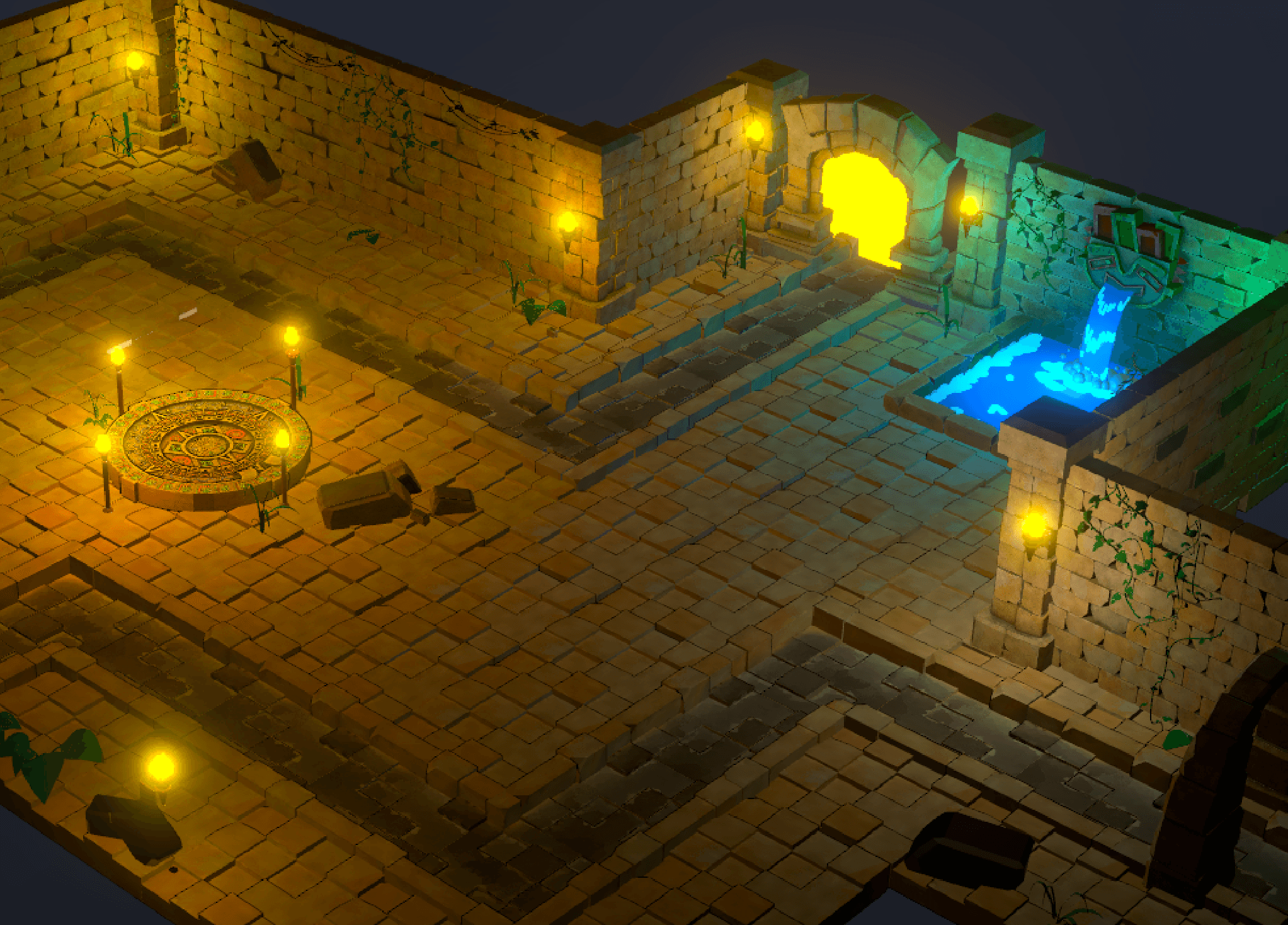
Sacred Child is a Tower Defense game where the player controls Xipe Totec, an Aztec deity protecting a child pursued by Tezcatlipoca, another deity.
Tezcatlipoca attacks the defender’s temple with various creatures. The player must defend the temple by placing towers and using magical abilities.
The core gameplay follows classic Tower Defense mechanics, enhanced with a tower combo system absent from the default TDTK. Towers can be linked together to mutually increase their power, adding a strategic layer.
🧩 Team
For our first Unity project, the team included two Game Design students and five 3D students:
Erwan Sevestre – Game Design / Level Design
Myself – Programming, production management, narrative, and 3D model integration
Tessa Omar – Art direction, 2D illustrations, and enemy modeling
Lucas Palandre – Shaders/VFX and modeling of environments and towers
Elian Lemaire – Modeling of some enemies and towers
Malo Heurlier – Tower modeling
Tom Noel – Tower and enemy modeling
🧠 My Contribution
Although TDTK provides a solid foundation, I added several features to customize the game and differentiate it from other groups:
Tower Energy System – Towers consume energy over time and can link to other towers to form combos, boosting each other’s power. Visual connectors show these links in the scene for clarity.
Interactive tutorial and contextual tooltips to guide players.
Cinematics and dialogue system – Automatically sequences dialogues, illustrations, and transitions, with a “typewriter” effect and synchronized audio.
Centralized audio management via a persistent singleton, maintaining music and sound continuity across scenes.
Dynamic animations for certain objects to enhance visual feedback.
The architecture is modular and maintainable:
Event-driven programming for tower interactions
Observer pattern for game state management
Coroutines for timed effects
Clear separation of responsibilities across systems
Additional systems include save/load, centralized resource management, enemy wave spawning, adaptive difficulty, and dialogue/cutscene management.
The codebase was designed to remain readable, modular, and extensible, facilitating testing and adding new mechanics.
🌱 Conclusion
Sacred Child was my first group Unity project. Despite bugs and the short three-week period, it was a substantial and formative experience, as I was the only team member familiar with Unity while also handling production and narrative design.
This project gave me valuable insight into the workflow of game artists and provided a strong foundation for future Unity projects.
Sacred Child
3D Tower Defense – Unity3D / TDTK
Developed by 7 students over three weeks as part of the third first-year workshop, in collaboration with the 3D class at BRASSART.
🎮 Game Concept
Sacred Child is a Tower Defense game where the player controls Xipe Totec, an Aztec deity protecting a child pursued by Tezcatlipoca, another deity.
Tezcatlipoca attacks the defender’s temple with various creatures. The player must defend the temple by placing towers and using magical abilities.
The core gameplay follows classic Tower Defense mechanics, enhanced with a tower combo system absent from the default TDTK. Towers can be linked together to mutually increase their power, adding a strategic layer.
🧩 Team
For our first Unity project, the team included two Game Design students and five 3D students:
Erwan Sevestre – Game Design / Level Design
Myself – Programming, production management, narrative, and 3D model integration
Tessa Omar – Art direction, 2D illustrations, and enemy modeling
Lucas Palandre – Shaders/VFX and modeling of environments and towers
Elian Lemaire – Modeling of some enemies and towers
Malo Heurlier – Tower modeling
Tom Noel – Tower and enemy modeling
🧠 My Contribution
Although TDTK provides a solid foundation, I added several features to customize the game and differentiate it from other groups:
Tower Energy System – Towers consume energy over time and can link to other towers to form combos, boosting each other’s power. Visual connectors show these links in the scene for clarity.
Interactive tutorial and contextual tooltips to guide players.
Cinematics and dialogue system – Automatically sequences dialogues, illustrations, and transitions, with a “typewriter” effect and synchronized audio.
Centralized audio management via a persistent singleton, maintaining music and sound continuity across scenes.
Dynamic animations for certain objects to enhance visual feedback.
The architecture is modular and maintainable:
Event-driven programming for tower interactions
Observer pattern for game state management
Coroutines for timed effects
Clear separation of responsibilities across systems
Additional systems include save/load, centralized resource management, enemy wave spawning, adaptive difficulty, and dialogue/cutscene management.
The codebase was designed to remain readable, modular, and extensible, facilitating testing and adding new mechanics.
🌱 Conclusion
Sacred Child was my first group Unity project. Despite bugs and the short three-week period, it was a substantial and formative experience, as I was the only team member familiar with Unity while also handling production and narrative design.
This project gave me valuable insight into the workflow of game artists and provided a strong foundation for future Unity projects.
Sacred Child
3D Tower Defense – Unity3D / TDTK
Developed by 7 students over three weeks as part of the third first-year workshop, in collaboration with the 3D class at BRASSART.
🎮 Game Concept
Sacred Child is a Tower Defense game where the player controls Xipe Totec, an Aztec deity protecting a child pursued by Tezcatlipoca, another deity.
Tezcatlipoca attacks the defender’s temple with various creatures. The player must defend the temple by placing towers and using magical abilities.
The core gameplay follows classic Tower Defense mechanics, enhanced with a tower combo system absent from the default TDTK. Towers can be linked together to mutually increase their power, adding a strategic layer.
🧩 Team
For our first Unity project, the team included two Game Design students and five 3D students:
Erwan Sevestre – Game Design / Level Design
Myself – Programming, production management, narrative, and 3D model integration
Tessa Omar – Art direction, 2D illustrations, and enemy modeling
Lucas Palandre – Shaders/VFX and modeling of environments and towers
Elian Lemaire – Modeling of some enemies and towers
Malo Heurlier – Tower modeling
Tom Noel – Tower and enemy modeling
🧠 My Contribution
Although TDTK provides a solid foundation, I added several features to customize the game and differentiate it from other groups:
Tower Energy System – Towers consume energy over time and can link to other towers to form combos, boosting each other’s power. Visual connectors show these links in the scene for clarity.
Interactive tutorial and contextual tooltips to guide players.
Cinematics and dialogue system – Automatically sequences dialogues, illustrations, and transitions, with a “typewriter” effect and synchronized audio.
Centralized audio management via a persistent singleton, maintaining music and sound continuity across scenes.
Dynamic animations for certain objects to enhance visual feedback.
The architecture is modular and maintainable:
Event-driven programming for tower interactions
Observer pattern for game state management
Coroutines for timed effects
Clear separation of responsibilities across systems
Additional systems include save/load, centralized resource management, enemy wave spawning, adaptive difficulty, and dialogue/cutscene management.
The codebase was designed to remain readable, modular, and extensible, facilitating testing and adding new mechanics.
🌱 Conclusion
Sacred Child was my first group Unity project. Despite bugs and the short three-week period, it was a substantial and formative experience, as I was the only team member familiar with Unity while also handling production and narrative design.
This project gave me valuable insight into the workflow of game artists and provided a strong foundation for future Unity projects.



PLAYABLE
PLAYABLE